
Report:

UK First Time Call Failure Rate 


Are your analogue telecare services failing? Each month we release a report on the First Time Call Failure rates that occurred the previous month, so you can have a clear view of how your TEC services may be being impacted.  

We have also introduced a new 3-month trend graph to track how failure rates are evolving over time.

Get the facts, access your report today.
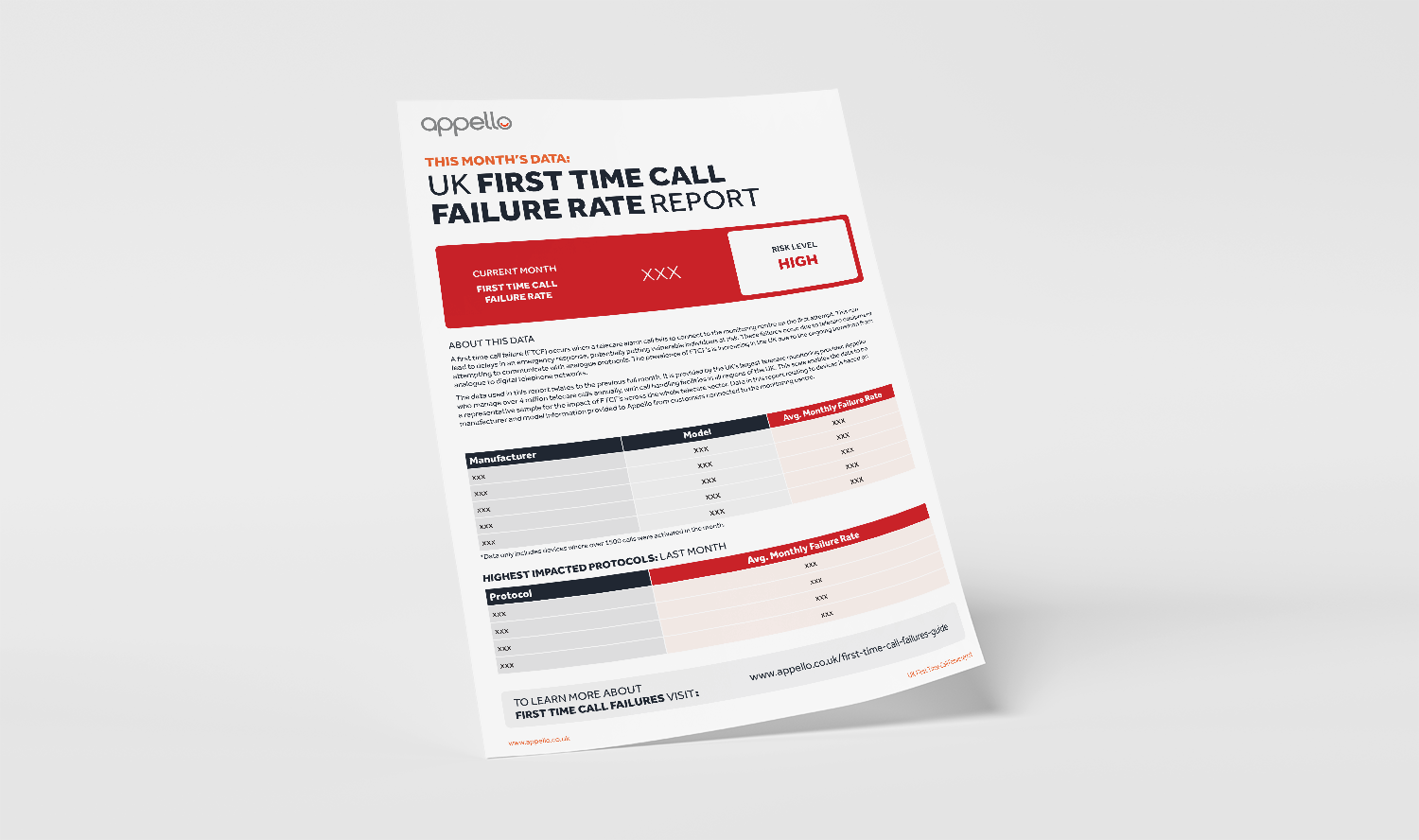
Cover Image_First Time Call Failure Report_v1


Why you must read...


Rate

Understand the current FTCF rate of 20.47% in the UK, highlighting the ongoing risks for telecare users during the analogue to digital transition.

Protocols

Identify the highest impacted telecare protocols, with TT 92 showing a failure rate of 23.75%, revealing key vulnerabilities in communication systems

Devices

Review the most affected telecare devices, including Tunstall with a 54.21% failure rate, ensuring you can prioritise upgrades effectively.

What to expect...

Appello, the UK’s largest telecare monitoring centre, is spotlighting the critical issue of analogue First Time Call Failures (FTCFs), with exclusive new data. These failures, where alarm calls don’t connect on the first attempt, pose serious risks to vulnerable individuals relying on telecare services.

 It is important to note that these figures likely underrepresent wider market failure rates, as we actively work with customers to resolve high-failing analogue schemes and remove them from the report once migrated to A2D converter or fully upgraded to digital.  

“It is a known risk that some analogue telecare devices may not be digitally compatible or perform as reliably on digital networks.”

Stephen Kinnock

Minister of State for Care
Department of Health and Social Care

500px-Dept-of-Health-and-Social-Care-horiz.svg-white 1

Download your full FTCF Report today.

By downloading our FTCF report each month you will be kept up to date with the current UK failure rates, the telecare equipment types most impacted, and the analogue protocols most vulnerable to failures—valuable insights to help you safeguard your residents effectively.